The video and slides from Simon’s keynote are now online under Courses > One-off events.
October 18, 2014
TD-PSOLA …the hard way

Time-Domain Pitch Synchronous Overlap and Add (TD-PSOLA) can modify the fundamental frequency and duration of speech signals, without affecting the segment identity – that is, without changing the formants. Normally, it’s an automatic algorithm, but here we do it the hard way – by hand! If you want to follow-along, you will need Audacity and these materials (a […]
Continue reading... October 30, 2015
Wave propagation on the surface of water

At the Alhambra (Granada, Spain) I saw this nice example of waves from a point source propagating in all directions at a fixed speed.
Continue reading... November 23, 2014
The Gaussian probability density function: understanding the equation
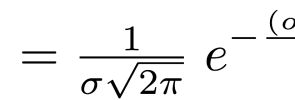
The equation for the Gaussian probability density function looks a little scary at first, but this video should help you understand what each of the terms is doing, and how they fit together. After watching the video download the spreadsheet which shows the calculations and plots from this video (tip: the Apple Numbers.app version includes images […]
Continue reading... October 11, 2014
Sampling and quantisation
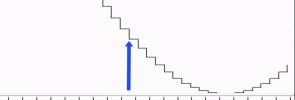
Is digital better than analogue? Here we discover that there are limitations when storing waveforms digitally. We learn that the consequence of sampling at a fixed rate is an upper limit on the frequencies that can be represented, called the Nyquist frequency. In addition to the limitations of sampling, storing each sample of the waveform as a […]
Continue reading... February 1, 2015
Autocorrelation for estimating F0
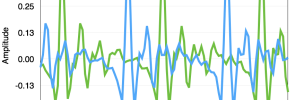
Most methods for estimating F0 start from autocorrelation. The idea is pretty simple: we are just looking for a repeating pattern in the waveform, which corresponds to the periodic vocal fold activity. For some waveforms, it might be possible to do that directly in the time domain, but in general that doesn’t work very well. […]
Continue reading... October 25, 2014
A super-simple speech recogniser
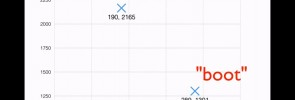
We make what is possibly the world’s simplest speech recognition system. It can only recognise two different words, but will help you understand the basic idea of pattern recognition using template matching. The templates are just pre-recorded words, with known labels. The features extracted are just two formant frequencies in the middle of the word, […]
Continue reading... October 11, 2014
Aliasing
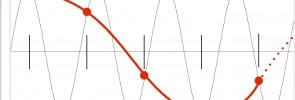
In sampling and quantisation we saw that sampling a signal at a fixed rate means that there is an upper limit on the frequencies that can be represented. This limit is called the Nyquist frequency. Before sampling a signal, we must remove all energy above the Nyquist frequency, and here we will see what would […]
Continue reading... October 11, 2014
Pipeline architecture for TTS
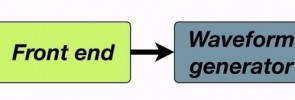
Most text-to-speech systems split the problem into two main stages. The first stage is called the front end and contains many separate processes which gradually build up a linguistic specification from the input text. The second stage typically uses language-independent techniques (although they still require a language-specific speech corpus) to generate a waveform. Here we see those two […]
Continue reading... October 11, 2014
Spectrum and spectrogram
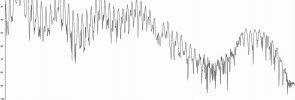
The spectrum and the spectrogram are much more useful ways of analysing speech signals than the waveform. We look at how to create them using Wavesurfer and what effect the analysis window size has on what we see.
Continue reading... October 31, 2015
The speed of sound

At the Parque de las Ciencias in Granada, Spain there is this long tube, open at the end nearest you and closed at the far end. We can calculate the length of this tube just from the audio recording, because we know the speed of sound. Here’s the waveform of part of the recording, showing […]
Continue reading... November 1, 2022
Bitrate

The bitrate (or bit rate) of a signal is the number of bits required to store, or transmit, 1 s of that signal. A bit is a binary number: either 0 or 1. Let’s calculate the bitrate of a digital waveform. First you should revise the concepts of sampling and quantisation from this module of the […]
Continue reading...


 This is the new version. Still under construction.